 MASQUERADE
QUEER POETRY IN AMERICA
TO THE END OF WORLD WAR II
SELECTED AND EDITED BY JIM ELLEDGE
WALTER DE CASSERES (1881-1900)
The Battle of the Passions 135
Phantoms 136
The Suicide 136
MASQUERADE
QUEER POETRY IN AMERICA
TO THE END OF WORLD WAR II
SELECTED AND EDITED BY JIM ELLEDGE
WALTER DE CASSERES (1881-1900)
The Battle of the Passions 135
Phantoms 136
The Suicide 136
Archived from: http://tresors.oublies.pagesperso-orange.fr/EnDehors/DeCasseres-Nocturne.htm
Il fait nuit.
Le voleur, éternel représentant de l’humanité, reprend son poste de guet au coin de la rue.
La prostituée, voyante et sybille, la première-née de Dieu, avive ses lèvres d’une teinte de rouge avant de descendre à la recherche de son repas.
Les cafés, les théâtres, les cinémas, avec leurs milliers de milliers de lumières commencent à marcher à la conquête de cet univers amorphe : l’ennui.
Dans les hôpitaux un vague mal-à-l’aise aiguillonne les corps des patients et les pensées, comme de noirs parasols, s’ouvrent en leurs cerveaux.
Dans des vêtements de soirée impeccables, les millionnaires — ces yoghis de la chair, parcourent de long en large els mille allées des jardins des établissements de luxe à la recherche de leurs ondulants Nirvanas.
Un poète, qui redoute davantage son propriétaire que le Très Haut, allume sa lampe sans abat-jour et commence une ode merveilleuse à la gloire du Renoir des Cieux.
Un mendiant, des yeux duquel la Faim a châtré le courage, demande qu’elle lui paie un café à une riche madame que son courage héroïque a mis pour toujours à l’abri des atteintes de la Faim.
La lune, momifiée dans un éternel sommeil — coprolithe gelé de la terre, — gravit, à l’Orient, les échelons de l’Espace, tel un reptile.
Il fait nuit, et le Cela, le « Ce qui est » aux yeux multiples et auxquels n’échappe rien, s’éveille de sa sieste subtile pour tenir sous sa surveillance le sous-monde des humains.
Benjamin DeCasseres
L’En-Dehors n° 331-332, Juin-Juillet 1939
Archived from: http://yesteryearsnews.wordpress.com/tag/benjamin-de-casseres/
Mason City Globe Gazette (Mason City, Iowa) Jul 3, 1931
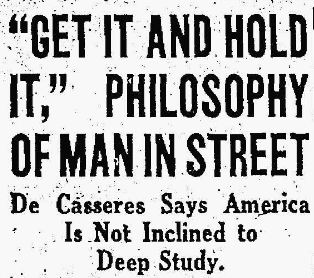
The philosophy of the man in the street is “get it and hold it,” in the belief of Benjamin de Casseres, poet and ironic philosopher, who says that after all this may be the most workable system for those to whom abstract theories are no more than the “Einstein theory to a gnat on a derby.” The article is one of a series on “what’s going on in the world today.”
By BENJAMIN DE CASSERES.
(Copyright 1931, by the Associated Press.)
NEW YORK, July 3. (AP) — Philosophy — which is, literally, the love of wisdom but which is in reality the art or science of explaining the how and why of things — has never had much of a vogue in America. Today less so than ever for the American cares very little about the how and why of things. His one question is: Will it work out?
He doesn’t philosophize on the current depression of his jobless condition or the contraction in stock values. He is not concerned, if he is a wet, how prohibition came on us. Nor will he take any steps, either personally or thru his legislative representatives, to prevent future moves of a like nature. He philosophizes thus: Here it is. Let’s dodge it if we can’t get out of it.
Philosophy In Way.
This attitude is, I suppose, a philosophy in a way — a lazy, do-nothing, good natured philosophy founded on the ineradicable and inherent optimism of the expansive soul who calls the state in which he happens to be born “God’s own country” and who believes “everything always comes out right in the end.”
That’s the philosophy, anyhow, of the man in the street. Of abstract thot he has not a glimmer. Theories of the universe, psychological problems and philosophical aphorisms and rules are no more to him than the Einstein theory to a gnat on a derby. His “wisdom” is “get it and hold it.” And I’m not sure that it isn’t the profoundest, the only and most workable system of philosophy so long as the world is peopled by practical, down-to-the-ground beings.
Boast Two Men.
In the regions of pure philosophical thot we boast of two men who have profoundly affected thot in Europe — Ralph Waldo Emerson and William James and one political philosopher whose influence has been universal, Thomas Jefferson.
Emerson and Jefferson, both advocates of extreme and aggressive individualism, and, theoretically at least, idealist — anarchists, are as dead in the country of their birth, so far as the public go, as prohibition in Hoboken. We move toward the standardization and destruction of all individual rights into pure capitalistic bolshevism, in which moloch-state becomes the absorber and keeper of all personal values.
Fits America.
William James, who gave us the philosophy of pragmatism — or what have you? — comes nearer to the ideal American philosopher, fits more neatly into the American character, than either Emerson or Jefferson.
Pragmatism is really a great and universal individual philosophy which makes the workableness — or “cash-down value,” as James calls it — of a thing the criterion of its truthfulness. He is, in a manner, the enemy of abstract thot. His antithesis is Remy de Gourmont, who said, “thots are to be thot, not acted.”
Does Not Exist.
Philosophy in the grand sense in American does not exist today. There is no love of thot for the pure gymnastic of cerebration. No one cares a hen’s molar about why anything happened or whether it will happen again.
All I can see ahead in America is Karl Marx, who was neither a philosopher nor a thinker, but a sensational utopist with a diabolical scheme for extinguishing the individual.
After all, what is wisdom? I think it is just to stand aside and watch the show. I, who am a philosopher, get a great kick out of it.
Archiving here. From: http://s-usih.org/2013/07/great-finds.html
After dredging through the New York Times online archives I’ve produced a list of all of the found Letters, Articles and Reviews published. Some of these were printed in Mirrors of New York, and many will be included in a future collection of DeC’s writing about New York to be published by Underworld Amusements.
Continue reading Letters, Articles and Reviews in the New York Times
Cut and pasting here for safe keeping…
Publication: Review of Contemporary Fiction
Author: Cohen, Joshua
Date published: April 1, 2011
I have thought of writing the lives of some great artist- Shelley, Manet, Beethoven, Shakespeare, Chopin, Keats, Sappho, Emerson, Nietzsche, Redon, for instancedirectly from a complete inhalation of and meditation on their work without any regard to the facts. Wherever the known facts conflict with my my thus, I shall reject them or flatly deny them. It would be a fascinating undertaking- the lives of Shakespeare, Chopin, Verlaine, for instance, as I conceive them to have been from their faces and work alone.
03-30-1934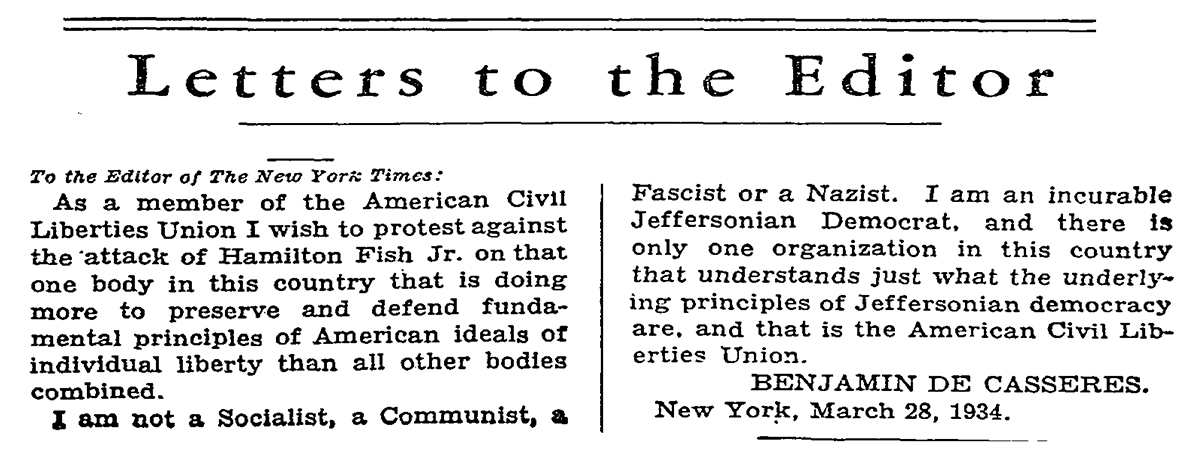
An early article from DeC published in The Theater magazine.
THE encore fiend, with his huge maulers and silly giggle, his bubbling, thumping, ear-splitting appreciation of everything that assails his lack-lustre eyes from the stage, has become such a nuisance in our places of amusement on first nights, second nights and all other nights that we think the time is ripe for a fuller appreciation of this most extraordinary specimen of the homo imbecilis.
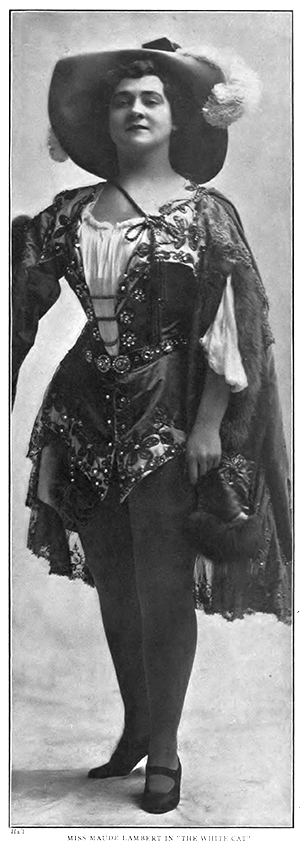
There he squats in all his brazen glory. He has come to enjoy the “show,” not, mark you, in the manner in which as a normal human being he would enjoy anything else, by finely discriminating between what he likes and what he does not like; but he has come to enjoy—”take in”—this particular part of his day’s more or less diverting experiences by a solemn compact with himself, not to be bamboozled, cozzened, or thimble-rigged out the equivalent for the two dollars he laid down at the box-office. And if the play is execrable, if the actor., are doing their unspeakable worst, if there is in all the dreary stuff never a smile or a real emotion—no matter. Go to! He’ll have his penny’orth of excitement willy-nilly. He’ll have his hands do the work that his judgment ought to be doing, if judgment the good God had given him. And while the rest of the audience wants to cool it heels in the lobby and its throat at the replenishing station next door, this maudlin vulgarian, exquisitely titillated by the work of his marvelous palms, has the curtain up again and again until the players themselves sneak knowing winks at one another, and even the manager looks at the arabesques in the carpet to keep a straight face. The Briareus of the stalls—who will deliver us from the body of this iniquity !
All our theatres are now equipped with opera glasses and acousticons. Why not hang from the back of each seat a box containing a huge watchman’s rattle? Ah ! that would be worth while. For a dime the fist-yammerer could then make Rome howl—even if they had not succeeded in doing so on the stage make each particular hair on each particular bald head to stand on end like javelins upon the fretful elephant, and drive each decent and self-respecting playgoer into the street, leaving the auditorium wholly in the hands of the high priests of hubbub.
Have you never been awakened out of a sound sleep at the end of act three when all the air a solemn stillness holds by “Speech !” “Speech !” “Speech !”? That is the tertiary stage of encoritis. Nobody wants to deliver a “speech,” nobody wants to hear a “speech,” nobody who is anybody asked for a “speech” —but behold ! the Palm has annexed a larynx, and tongues have sprouted on the night. The author, the manager, the star, anybody, will satisfy this unfortunate who has come among us. Just to see a real live man appear between the footlights and the fallen curtain, and hear those inspiring words: “Ladies and gentlemen, in the name of the company and myself—,” and all the rest of the platitudinous palaver that goes by the name “speech”—just to hear that and nothing more, brings the bliss that passeth understanding to the soul of the encoritic and satisfies him until the last act, when, emerging from his trance at seeing particeps criminis before the curtain, he will yet linger for a good-night love-tap.
Applause—the real simon pure article—is something that brings as much joy to the auditor who never applauds—we all know him, the fellow whose face is pipe-jointed to his Dignity, and who is afraid to let out a link in his macadamized attitude—as to the players on the stage. In the third act of “Zira,” when Margaret Anglin spins the web of despair all about her to break it in a whirlwind of defiance and then collapses into a heart-splintering confession, or when James K. Hackett in a splendid outburst pronounces his now famous anathema maranatha on the lady cigarette smokers and the finely upholstered man-killers of Mayfair, and in mighty vocables and unsterilized staccato smashes the smart set to infinitesimal Hinders that pretty nearly knocks down the Coca-Cola sign in Long Acre Square, the audience is carried off its feet and fairly bellows its appreciation. This is all very different from demanding of Edna June a repetition for the tenth time of “Under the Beerbohm Tree.”

Then, too, this scurvy encore fellow has no regard for the actor or singer. It was long ago officially announced by Mr. Mansfield that actors have rights which the public is bound to respect. Neither age, role, nor previous condition of perspiration is safe from the onslaught of the encoritic. His fiendish purpose is never satiated until he has seen all the company linky-hand, then he must see each bored countenance stand in the centre of the stage and bow its approval to this ass in evening raiment. Voices are worn down, but that is nothing to him; shoe-leather worn out, but that is nothing to him—an actor, a singer encored to death, but that is nothing to him.
It was the last night of all Time. Through the infinite darkness there reigned the calm that was to precede the Final judgment. From the east there flared intermittently yellow and purple-green lights, and the last of the earth-men, seeing these things, cowered deeper and deeper into their burrows. But the end had come. Sulphur and ashes filled the universe and giant sidereal systems flashed into flaming pyres, whose flames licked the roof of the Zenith. World rattled against world, comets clove the solid earth of the younger worlds and belched their fires to the furthest spaces. And over against the east, where the first dread flashes had been seen, the Angel Gabriel rose, and on his face there lay the marmoreal silence of eternity, and upon his trumpet that reached unto the last outpost of Space he blew the three prophetic blasts. And from out that grinding war of atoms and stupendous impact of force on force, through the hellish murk and lurid lights of vanishing worlds, there emerged the figure of a man who once had dwelled on earth. As the last trumpet-call died away the man smote one palm upon another in wild applause, and, with eyes fixed upon the face of Gabriel, he called wildly thrice : “Speech!” “Speech!” “Speech!” It was the encore fiend.
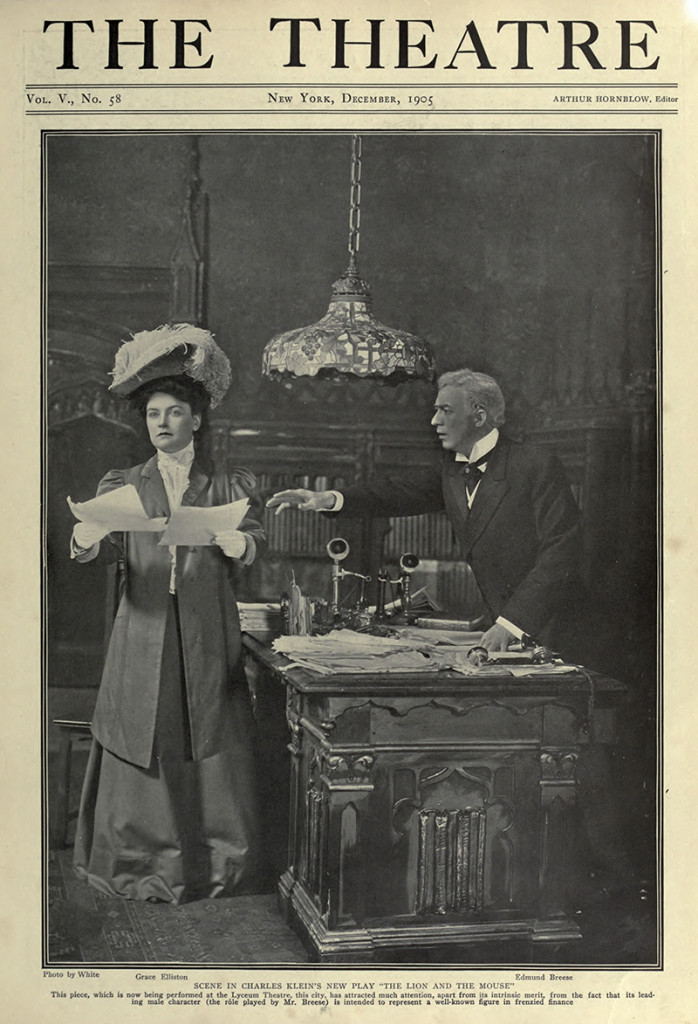
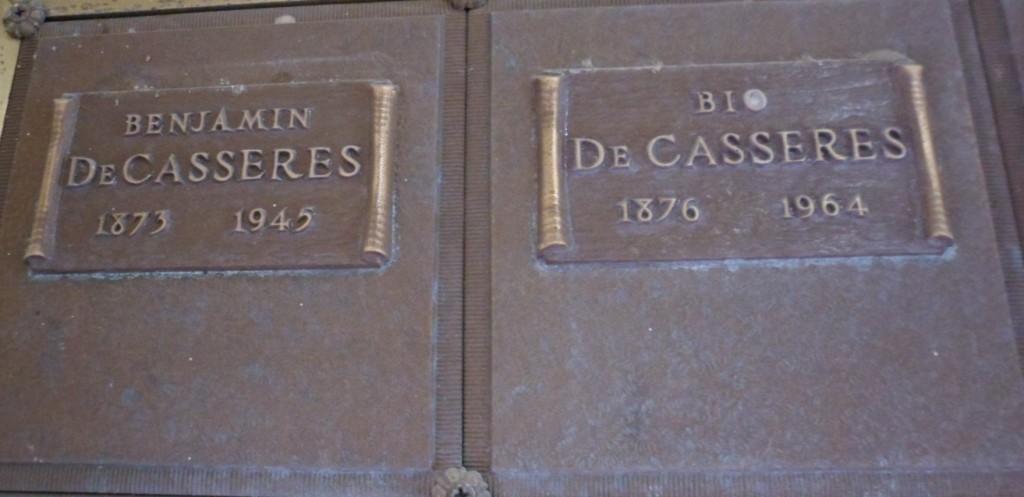
South Lawn Memorial Cemetery
Tucson
Pima County
Arizona, USA
Plot: Skylawn Mausoleum, Unit 5
It was an initial thought that “Blackstone Publishers” might have been a name DeC used to release his own “DeCasseres Books“, though I have stumbled across a few other titles attributed to them from the same period NOT by or about DeCasseres:
The Washington Nursery by Katharine Emerson Hovey Seabury, 1936
Yerusholayim Shel Matah by Uri Tzvi Greenberg / Cowen, Charles A. (trans.), 1939
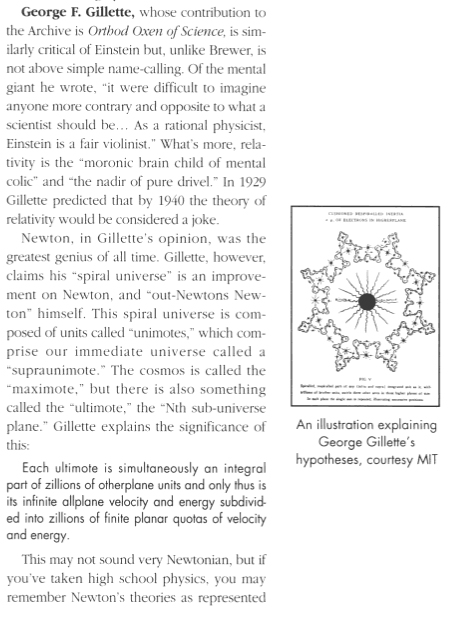
Orthod Oxen of Science by George F. Gillette, 1936
It’s possible DeC published these titles under his own imprint. Two of the titles are poetry, one is crazy cosmic pontification.
Details from various web sources on each title:
The Washington nursery
Author: Katharine Emerson Hovey Seabury
Publisher: New York : Blackstone Publishers, ©1936.
Genre/Form: Satires / Anecdotes
Document Type: Book
Fly title: a short history for babies–just babies.
Issued in illustrated & printed buff wrappers.
Description: 16 pages ; 17 cm
Other Titles: Short history for babies
Responsibility: by K.E.S.
Jerusalem: Yerusholayim Shel Matah
Rinberg, Uri Tzvi
Trasnslation from the hebrew by:
Cowen, Charles A.
Blackstone Publishers
New York 1939
8°. 43 p.
This is a different listing of the above,
GREENBERG, URI ZVI & CHARLES A. COWEN (transl. and introd.). – Jerusalem. Yerushalayim Shel Matah.
New York, Blackstone Publishers, 1939. Orig. gold-printed stiff black wraps. with stapled blue cloth spine; rusty staples, top of spine worn and with small library label. 46 pp.; some annotations in pencil in margin. EUR 20.–
~First American edition. Eight poems by Greenberg, introduced by Cowen.
Orthod Oxen of Science: Synoptic conspectus of author’s Unitary Theory.
Published by George F. Gillette,
Author of Unity of Universe, Cycle of Power, Rational Non-Mystical Cosmos
at the Blackstone Publishers
New York City, 1936.
(more on this one here: http://www.logiston.com/oddends/2007/05/the-mystic-mistooks-witch-doctors-of-science/ )
Orthod Oxen of Science was referenced in Donna Kossy’s book KOOKS, by Feral House… here is an excerpt:
Here is a current image of 117 West 27th St., New York, the address listed for Blackstone Publishers in the DeCasseres Books:

While I’m here, I stumbled across this item:
http://www.angelfire.com/nb/shestov/fon/fondane_full.html
Conversations with Lev Shestov
by Benjamin Fondane
February 17, 1937
– You remember Casseres (the American writer). I told you once that he had published a book on four or five big names: Buddha, Spinoza, Nietzsche, Jules de Gaultier. I can’t remember who was the fifth there. J. de Gaultier probably sent him my “The Good in the teaching of Tolstoy and Nietzsche”, judging from the foreword he wrote. I suppose this is how Casseres discovered my books. He just published an article about me, “Samson in the Temple of Fatality” [*]. Seeing the title, I thought he understood what it was all about. But from what I could decipher (it’s in English), he begins with a discussion of my style; I immediately saw that it was not going to be good. I remember a philosopher who once wrote to me that my style is so impressive that it makes one forget all the rest.
[Benjamin De Casseres, “Chestov: Samson in the Temple of Fatality”, chapter 3 of the book “Raiders of the Absolute”, New York, The Blackstone Publishers, 1937, 56 p]