“Hope and wisdom are contradictory terms.”
DeCasseres Quotes…


Short biography of DeC’s love “Bio”…
From “Biography of the Mack Families as Compiled by Marguerite Olds Year of 1968”, the accuracy of it has not been verified, though there are some obvious errors at least typographically):
“Adella Mary Terrill was born on May 4, 1875 at Mankato, Blue Earth Reservation, Minnesota. She received her elementary education in Mankato, and went with her sister Sadie to Pueblo, Colorado to help her stepsister Matilda Provost in running her rooming house and dining room. Here she met Harry C. Homes her first husband with whom she lived for many hears in Tonepah, Nevada. Harry Jones was both a writer and a promoter and it was on one of his business trips to New York to obtain financing for a silver mine promotion that Adella met Benjamin DeCasseres which
caused the start of many letters passing between them, and finally caused the divorce of Harry Jones and Adella. It was fourteen years that they sent love letters to each other but did now see one another. Adella was a selfish but loveable woman.In one of her letters to her sister, she said that she had no more love now for her mother than she had when a child. Just a kindly feeling toward her. She said that
her mother had no conception of truth or of beauty of the lofty things that dwell deep with you. This letter was written in 1906. She was left alone much of the time during her marriage with Harry Jones, and she vented some of her feelings in her letters to Benjamin DeCasseres. Mr. Jones finally gave her up in 1919, when Adella received her divorce from him. She made life miserable for Harry, as she was so in love Benjamin. In one of her letters from Harry before the divorce, he spoke of being very sad, but if she really wanted a divorce he would give her permission to get it, which
she did immediately.She married Benjamin DeCasseres, who was born on April 3, 1873 at Philadelphia, Pennsylvania. He was educated in the public schools there. He left school at the age of thirteen to work on the Philadelphia newspapers. He became a poet, and author, a columnist, and an editorial writer for the Mirror in the years between 1892 and 1899, when he went to New York to work for the New York Sun, and four years
later with the Herald. He contributed to the Cosmopolitan, Metropolitan, Life, Judge, American, Mercury, and many others. He became a noted dramatic critic and his writings appeared in Arts and Decorations and the Motion Picture Herald and
Screenland. He also was on the editorial staff from 1919 to 1923 of Famous Player, Loskey, and Universal Pictures. He died on September 7, 1945, and Adelle (Bio, the nickname that Benjamin gave her) died in 1964 in Tucson, Arizona, where had moved to at the death of her husband. Adelle willed all of her personal and household affects to the Rockton Township Historical Society to be used to the best of their advantage. As far as we know, Adelle had no children by either of her husbands.”
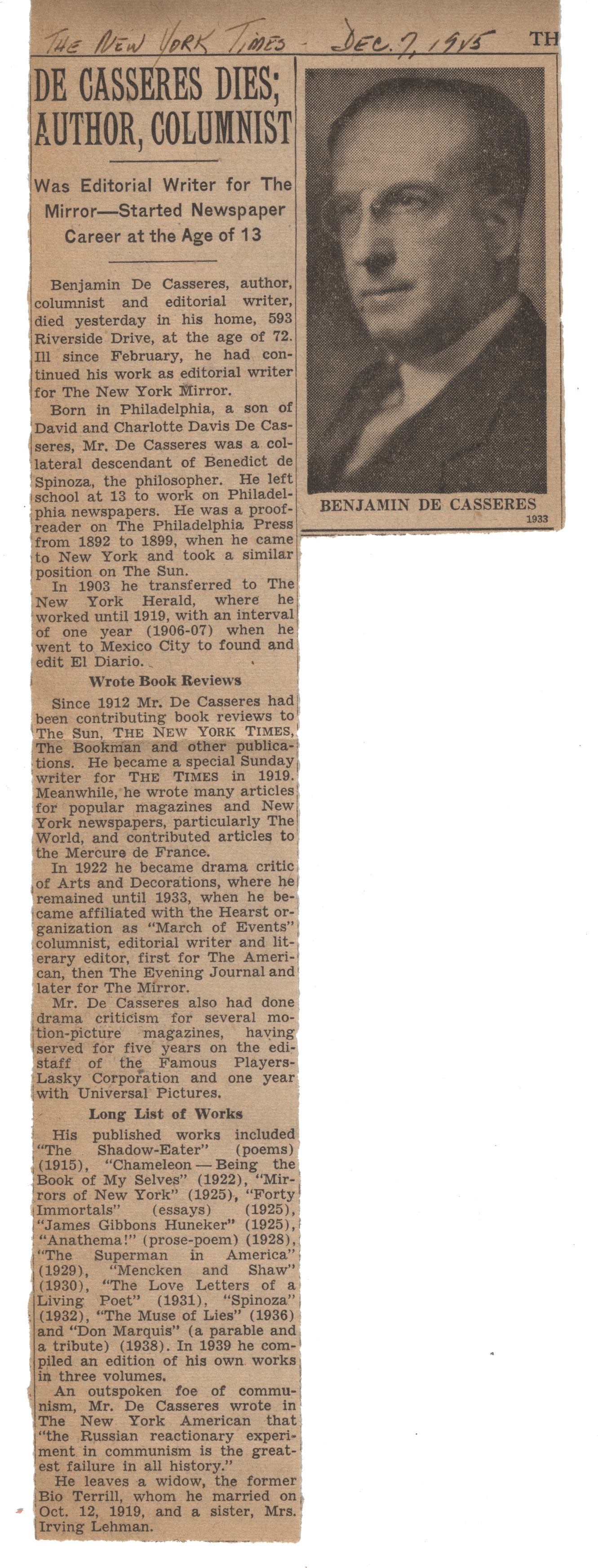
NYT Obit, Dec. 7th, 1945
“Why We Are Thankful”
Originally printed in JUDGE, November 1918
ONCE upon a time man had no Thanksgiving Day. He swore at his gods when there was no rain, prayed to them in winter before the era of the snowplough, and sacrificed to them the beasts of the field and a few enemies before he started out to annex a bit of kultur from the bodies and lands of neighboring tribes.
Time passed (and if you ever notice your clock you will observe that that is an old habit which old Kronos cannot rid himself of). And as time passed, man learned how to smoke the pipe of peace. He actually began to observe that the tribe that lived over the garden wall wasn’t one hundred per cent. yellow. And with peace came more wampum — the price of poisoned arrowheads decreased and the family sugar bowl filled up.
He had time to meditate — to look around on the good old garden patch, Mother Earth, to observe that the stars didn’t bother anybody much except once in a great while, when the heavens, in a grouch, let fly a comet at the earth.
So one day Man went out into the fields — he was still rather raw and hazy about Liberty, Rent Values and Birth Control — stripped off his fighting duds, and mumbled out thanks to Something or Other that the baby’s tooth had come across, that the squaw looked pretty nice that day and that the fishing was good.
That was the first Thanksgiving Day of Man. He got rid of something on his chest — a sense of gratefulness for little things — and resolved, no doubt, to be a more human murderer and a not-quite-so-lazy husband in the future.
From that day to Thanksgiving, 1918, a great deal of human blood has flowed under the mills of the Gods. There have been many things to be thankful for and a great many things to pout at, and a whole lot of things to cuss about. You and I—that is, the human race, for from the beginning they, all of them, have been blood of our blood and bone of our bone (don’t you feel it in this most human time?) — have done pretty well, considering that we have been up against famine, flood, comets, wars, Nature’s sunny cynicism, the decrees of kings, Intolerance, the natural perversity of Things in General, poverty, the flesh, the devil and the Hun.
Yes, we’ve done pretty well. We — you and I — have flowered into a Sophocles, a Shakespeare, a Michael Angelo, a Beethoven, a Leonardo da Vinci, a Darwin, a Newton, a Galileo, a Voltaire, a Mark Twain — the role of our great names would take up an issue of JUDGE.
Yes, we have done pretty well — considerin’. Racially, let us give thanks to whatever gods will listen for Music, Painting, Science, Literature, Dancing, and even the spirit of Humor. We — you and I — have laughed in the face of hell — and of that laugh there was born a star — Art, and its satellite, Pleasure.
Today, in this Thanksgiving season, we who are real men and women thank those same blind and wilful gods that we are alive.
We have stood to our breasts in blood; but we have lived and helped, and feared not.
We have stood, in these four years, at the crossroads of civilization, and fought a thug in the dark — the Hun. We have not forgotten our birthright, Liberty. We have stood and died beside France and Belgium; and each has made the supreme sacrifice — in his way.
This Thanksgiving Day, 1918, is a day for all brave men and brave women, and our brave boys and beautiful girls. It is a day not of night, or sorrow, or the quenchless agony of the battlefields, but a day of gleaming splendor. Never in the history of humanity have such great and unselfish deeds been ‘done; never has there been a time of such beatific martyrdoms; never has there been a time of such unselfishness.
Thanks, thanks, thanks, then, a thousand times, to whatever gods there be for the revelation of mankind unto itself—for the privilege of seeing ourselves in the blazing mirrors of Verdun and Château-Thierry and Ypres and the Marne as we are—neither beasts quite, nor angels quite, but Men and Women with a mysterious destiny battling for a Vision.
And thanks, O thou mysterious Fate that rules us, that we are Americans, and that we have made the sublime gesture of history to enslaved humanity; that thou hast made us strong and implacable in its hour of need; and thanks for sealing with blood our friendship with France, our beautiful, all-suffering sister!
And receive thou our immortal dead into Thy mysterious Presence!
D’Annunzio
Titan of earth and air,
Of Dante and Hugo the heir,
Stamped with an almighty Dare—
The gods of Valhalla salute thee!
Superman, demi-god, singer,
Gabrile, called the Light-bringer,
Anointed by Dionysiac finger—
Napoleon and Nelson salute thee!
Triumph of Force and Life,
Red Rose of Vision and Strife,
Spurning the reed and the fife—
The trumpets of Asgard salute thee!
Shoulder him up the stars
To the realm of the Avatars,
First-born of Venus and Mars!
The dead of the Marne salute thee!
—
From IMP: The Poetry of Benjamin DeCasseres.
IMP: The Poetry of Benjamin DeCasseres
http://
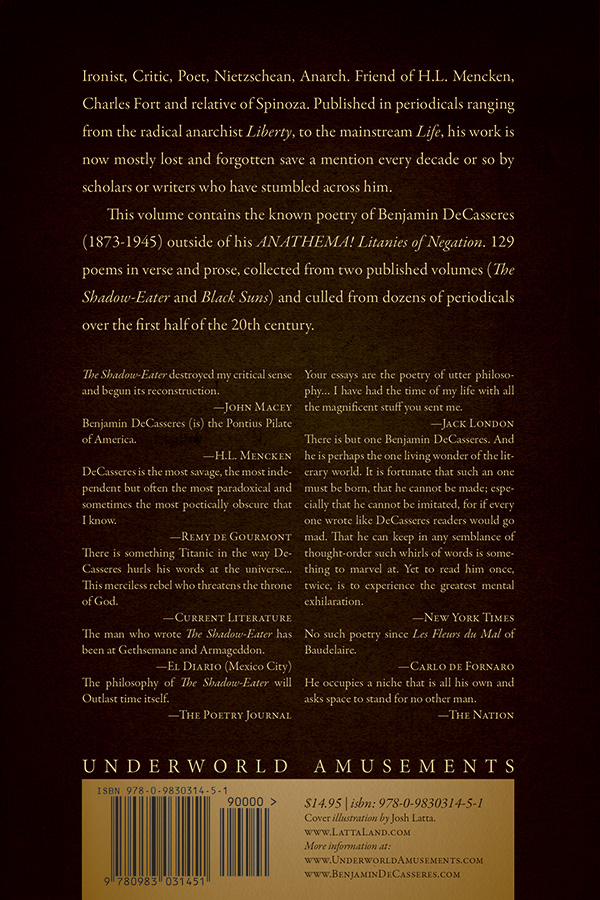
Ironist, Critic, Poet, Nietzschean, Anarch. Friend of H.L. Mencken, Charles Fort and relative of Spinoza. Published in periodicals ranging from the radical anarchist Liberty, to the mainstream Life, his work is now mostly lost and forgotten save a mention every decade or so by scholars or writers who have stumbled across him.
This volume contains the known poetry of Benjamin DeCasseres (1873-1945) outside of his ANATHEMA! Litanies of Negation. 129 poems in verse and prose, collected from two published volumes (The Shadow-Eater and Black Suns) and culled from dozens of periodicals over the first half of the 20th century.

The Shadow-Eater destroyed my critical sense and begun its reconstruction.
—John Macey
Benjamin DeCasseres (is) the Pontius Pilate of America.
—H. L. Mencken
DeCasseres is the most savage, the most independent but often the most paradoxical and sometimes the most poetically obscure that I know.
—Remy de Gourmont
There is something Titanic in the way DeCasseres hurls his words at the universe… This merciless rebel who threatens the throne of God.
—Current Literature
The man who wrote The Shadow-Eater has been at Gethsemane and Armageddon.
—El Diario (Mexico City)
The philosophy of The Shadow-Eater will Outlast time itself.
—The Poetry Journal
Your essays are the poetry of utter philosophy… I have had the time of my life with all the magnificent stuff you sent me.
—Jack London
There is but one Benjamin DeCasseres. And he is perhaps the one living wonder of the literary world. It is fortunate that such an one must be born, that he cannot be made; especially that he cannot be imitated, for if every one wrote like DeCasseres readers would go mad. That he can keep in any semblance of thought-order such whirls of words is something to marvel at. Yet to read him once, twice, is to experience the greatest mental exhilaration.
—New York Times
No such poetry since Les Fleurs du Mal of Baudelaire.
—Carlo de Fornaro
He occupies a niche that is all his own and asks space to stand for no other man.
—The Nation
“…at last the masses arrive at Democracy! The divine right of kings has become the divine right of the masses. The crown has been taken from the head of the ass and glued on the head of the ape. We pass from an assocracy to an apeocracy”
The Borrowed Mirror
“What will other people think?” is the most cowardly phrase in use in society. Only weak men stand in fear of the censure of the neighborhood.
Whatever is great in life brings down censure upon the head of the doer.
A man who lives, moves, and has his being in other people’s opinions has not risen to the level of animal intelligence. The dog and horse are at least sincere and natural in all their acts.
Why not dress your life before your own mirror ?
Look for your reflection in your own mind. There is a secret judge of all your acts within you. Conscience is your private opinion of yourself.
Why borrow a thing when you possess it yourself ? What does it matter what others think of your actions? What do you think of them ?
Some men crouch, crawl, and skulk all their lives. They are cowed by a whisper; their purpose is shaken by a look. They run like sheep before somebody’s opinion, though they would return blow for blow if they were attacked on the highway.
They are larded, greased, and curled wax figures. Whenever they move you know that Public Opinion has pulled a wire somewhere. When they speak you know what they will say. They are not men enough to offend.
The ogre, Public Opinion, slays more originality and individuality than all the barbarous superstitious codes put together. It is the modern Moloch before which we all meekly bend.
That shameful hypocrisy which permeates society everywhere is born of the fear of other people’s opinions. Sincerity and plain speaking are at a premium everywhere. We lie from morning until night, and pretend to things we abhor.
Turn once upon that lazy braggart, Public Opinion, and see it scamper away.
It is our latest idol, the modern social Juggernaut.
“A catchword—Socialism, Progress, Democracy—has saved many a man from the gutter. A “sublime enthusiasm” differs in no respect from the exaltations of opium and alcohol, though the dreamer is infinitely more dangerous and asinine than the dipsomaniac and drug fiend. The drunkard enslaves himself only; the dogmatic enthusiasts always end by enslaving others. There is no maniac comparable to an active idealist.” – B.DeC