Damon Runyon answers Benjamin DeCasseres, who had stepped into a debate over O. Henry and Bret Harte and then taken a pop at Runyon’s claim that Harte was the more classic of the two. Runyon recalls him as “The Mad Poet” of the old roaring forties. We haven’t yet identified DeCasseres’ original article; the 1940-onward bibliography has no entry on O. Henry shortly before this August 5, 1942, column. Here is Runyon’s “The Bright Side” as it ran in The Times-Union.
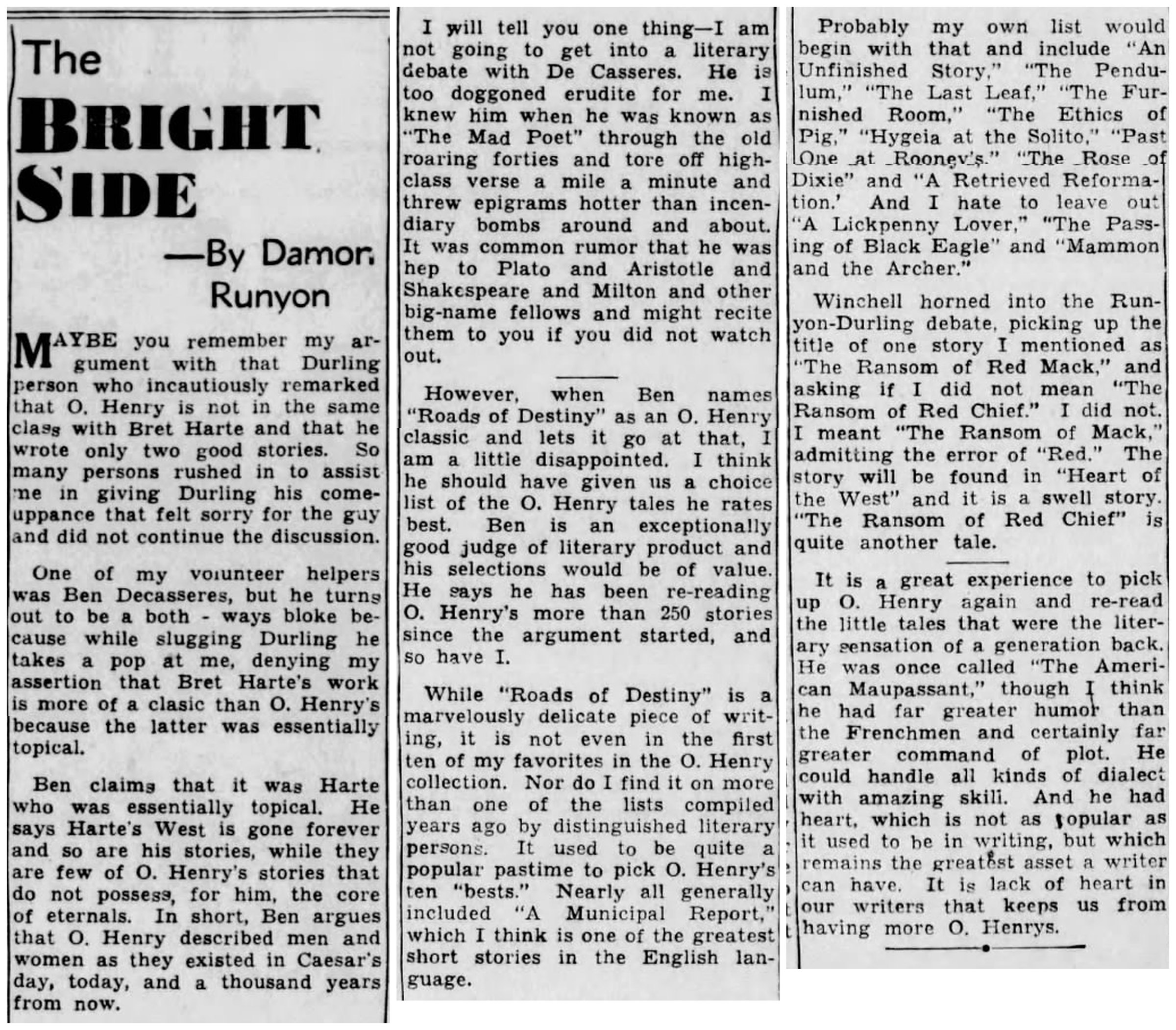
The Bright Side
By Damon Runyon
MAYBE you remember my argument with that Durling person who incautiously remarked that O. Henry is not in the same class with Bret Harte and that he wrote only two good stories. So many persons rushed in to assist me in giving Durling his comeuppance that felt sorry [sic] for the guy and did not continue the discussion.
One of my volunteer helpers was Ben Decasseres, but he turns out to be a both-ways bloke because while slugging Durling he takes a pop at me, denying my assertion that Bret Harte’s work is more of a clasic [sic] than O. Henry’s because the latter was essentially topical.
Ben claims that it was Harte who was essentially topical. He says Harte’s West is gone forever and so are his stories, while they are few [sic] of O. Henry’s stories that do not possess, for him, the core of eternals. In short, Ben argues that O. Henry described men and women as they existed in Caesar’s day, today, and a thousand years from now.
I will tell you one thing—I am not going to get into a literary debate with De Casseres. He is too doggoned erudite for me. I knew him when he was known as “The Mad Poet” through the old roaring forties and tore off high-class verse a mile a minute and threw epigrams hotter than incendiary bombs around and about. It was common rumor that he was hep to Plato and Aristotle and Shakespeare and Milton and other big-name fellows and might recite them to you if you did not watch out.
However, when Ben names “Roads of Destiny” as an O. Henry classic and lets it go at that, I am a little disappointed. I think he should have given us a choice list of the O. Henry tales he rates best. Ben is an exceptionally good judge of literary product and his selections would be of value. He says he has been re-reading O. Henry’s more than 250 stories since the argument started, and so have I.
While “Roads of Destiny” is a marvelously delicate piece of writing, it is not even in the first ten of my favorites in the O. Henry collection. Nor do I find it on more than one of the lists compiled years ago by distinguished literary persons. It used to be quite a popular pastime to pick O. Henry’s ten “bests.” Nearly all generally included “A Municipal Report,” which I think is one of the greatest short stories in the English language.
Probably my own list would begin with that and include “An Unfinished Story,” “The Pendulum,” “The Last Leaf,” “The Furnished Room,” “The Ethics of Pig,” “Hygeia at the Solito,” “Past One at Rooney’s,” “The Rose of Dixie” and “A Retrieved Reformation.’ And I hate to leave out “A Lickpenny Lover,” “The Passing of Black Eagle” and “Mammon and the Archer.”
Winchell horned into the Runyon-Durling debate, picking up the title of one story I mentioned as “The Ransom of Red Mack,” and asking if I did not mean “The Ransom of Red Chief.” I did not. I meant “The Ransom of Mack,” admitting the error of “Red.” The story will be found in “Heart of the West” and it is a swell story. “The Ransom of Red Chief” is quite another tale.
It is a great experience to pick up O. Henry again and re-read the little tales that were the literary sensation of a generation back. He was once called “The American Maupassant,” though I think he had far greater humor than the Frenchmen and certainly far greater command of plot. He could handle all kinds of dialect with amazing skill. And he had heart, which is not as popular as it used to be in writing, but which remains the greatest asset a writer can have. It is lack of heart in our writers that keeps us from having more O. Henrys.
“The Bright Side,” by Damon Runyon, The Times-Union (Albany, NY), August 5, 1942, p. 12, via Newspapers.com.